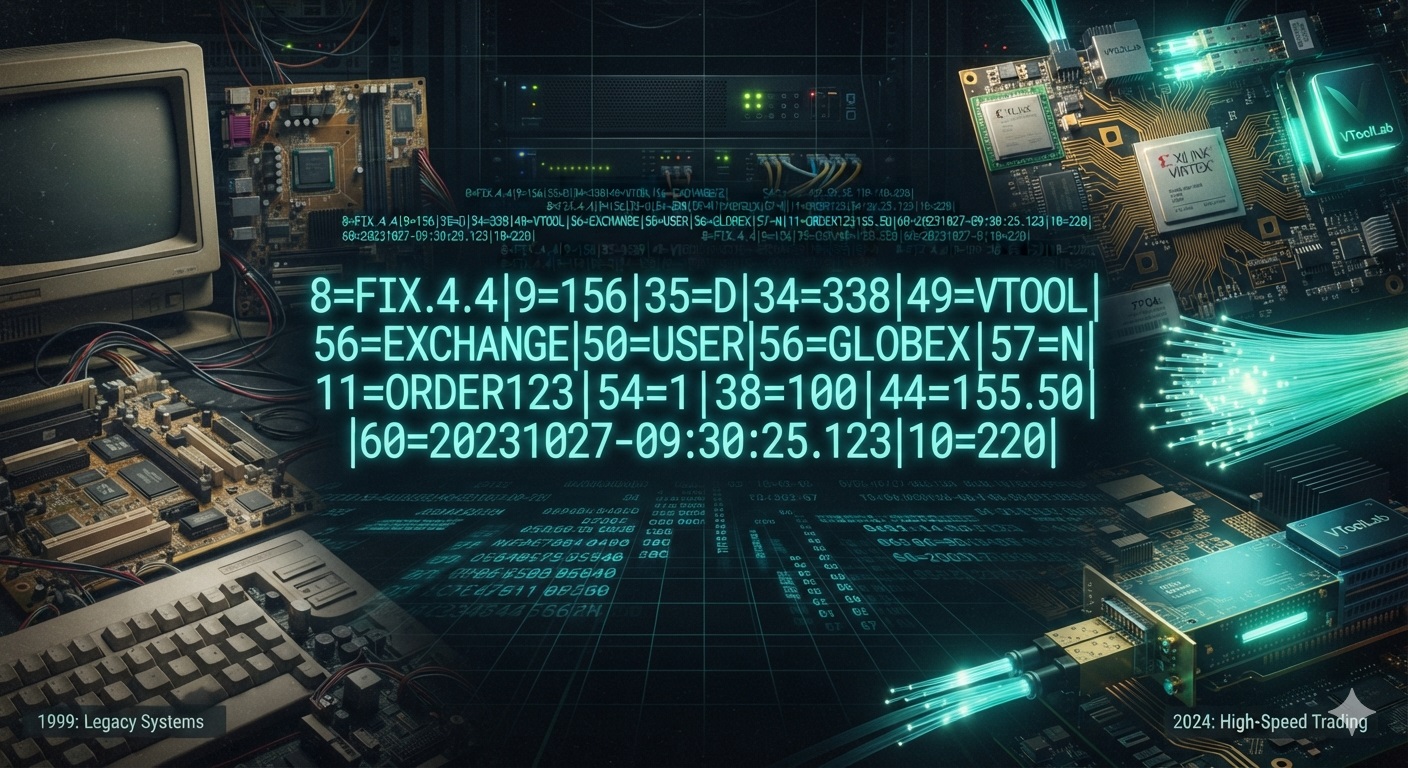
In the multi-trillion dollar trade flow, candlesticks are just the surface. The true pulse lies in a seemingly dry text protocol: FIX (Financial Information eXchange). It is the global lingua franca of institutional trading.
I. Origins: The 1992 “Digital Handshake”#
Before the 1990s, Wall Street relied on phones and faxes. In 1992, Robert Lamoureux (Fidelity) and Chris Morstatt (Salomon Brothers) automated equity trade confirmations using a minimalist Key-Value format.
- 1992: FIX 2.7 is born.
- 2000: FIX 4.2 establishes the rigorous Sequence Number and Persistence mechanisms, ensuring financial data “atomicity”—never losing a single bit.
- 2003: FIX 4.4 introduces support for complex derivatives and algorithmic trading, becoming today’s global quant standard.
II. The China Context: From FIX to STEP#
China’s major exchanges (SSE, SZSE, CFFEX) adopted STEP (STandardized Exchange Protocol) based on JR/T 0022-2014.
- FIX 4.4 Dialect: STEP utilizes FIX 4.4 as its blueprint but extends it with thousands of custom tags (Tag 10000+).
- Logic Coupling: In STEP, every Execution Report (35=8) is not just data—it conveys real-time clearing logic for the T+1 A-share market.
III. The Performance War: From ASCII to Binary#
As High-Frequency Trading (HFT) reached sub-microsecond scales, traditional text parsing became a bottleneck.
1. The ASCII Era (Tag=Value)#
- Pros: Human-readable, easy to debug.
- Cons: CPU must scan every byte for the
\x01delimiter. High overhead.
2. SBE (Simple Binary Encoding)#
The current physical peak. It abandons dynamic structures for Fixed Offsets.
- Principle: The CPU reads data via direct memory address offsets rather than “parsing” strings.
- Result: Processing latency drops from 50μs to under 1μs (1000ns).
IV. The Modern Frontier: FPGA Hardware Sockets#
In top-tier quant labs, protocol logic has moved to the hardware layer. Incoming packets are deconstructed directly on FPGA chips, bypassing the CPU entirely. Execution happens before a standard software stack even senses the packet’s arrival.
V. VToolLab: Deterministic Tools for Protocol Auditing#
To help developers navigate the “Non-deterministic” gaps in FIX/STEP integration, VToolLab offers the v-fix Suite:
- v-fix-client: A protocol probe that translates raw streams into semantic, color-coded views with integrated RTT latency measurement.
- v-fix-server: A 24/7 simulation sandbox that mimics broker matching engines (Execution Reports), enabling logic validation regardless of market hours.
Conclusion#
The essence of Fintech is finding deterministic execution paths within non-deterministic markets. Understanding the underlying protocol is essential for every quantitative engineer.